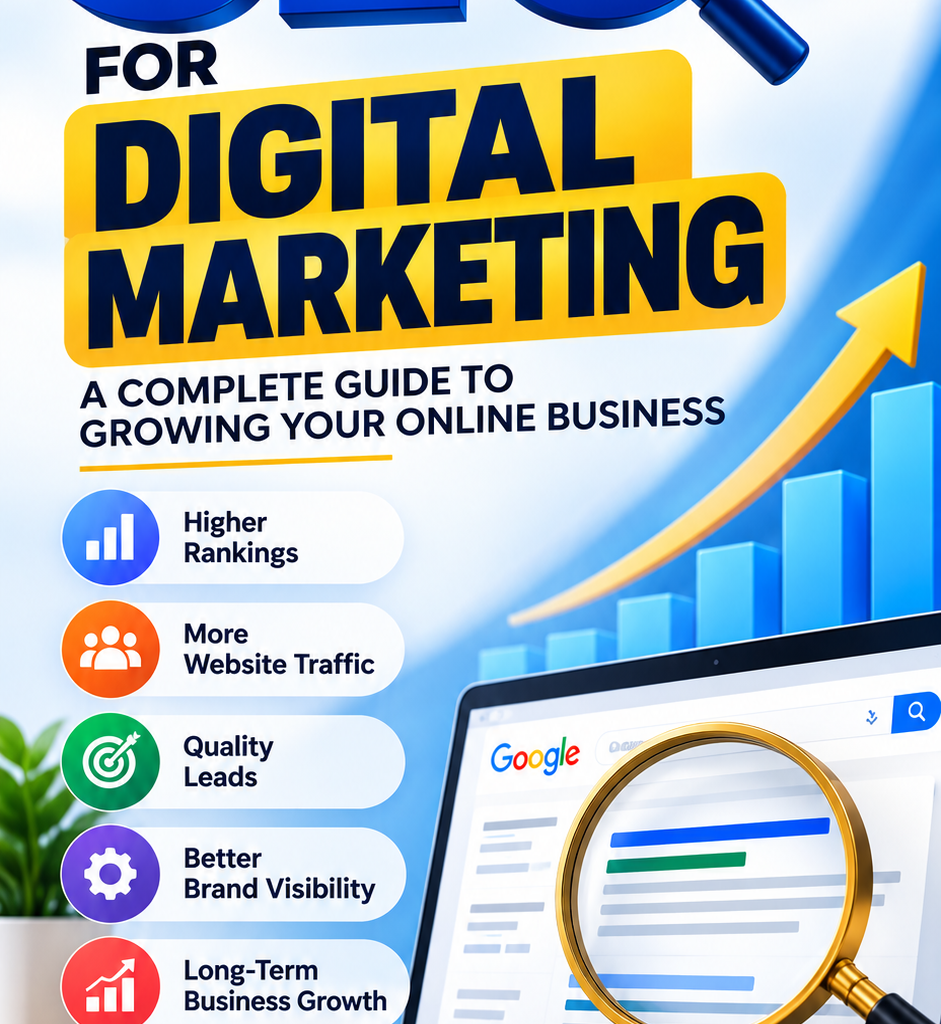
In today’s competitive online market, having a website is not enough. Businesses need to make sure their website appears in search engine results when potential customers are looking for their products or services. This is where SEO for digital marketing plays an important role.
Search Engine Optimization (SEO) helps businesses improve their online visibility, attract relevant visitors, generate leads, and build long-term organic traffic without depending entirely on paid advertising.
What Is SEO in Digital Marketing?
SEO, or Search Engine Optimization, is the process of improving a website so that it can achieve better visibility in search engine results such as Google and Bing.
SEO is an important part of digital marketing because it helps connect businesses with people who are actively searching for their products, services, or information.
For example, if someone searches for “digital marketing agency near me”, businesses with a well-optimized website have a better opportunity to appear in relevant search results.
Why Is SEO Important for Digital Marketing?
SEO supports several important digital marketing goals:
1. Increase Organic Website Traffic
A properly optimized website can attract visitors from search engines without paying for every individual click. Consistent SEO work can help a website gain organic traffic over time.
2. Improve Online Visibility
SEO helps search engines understand your website, pages, services, and content. Better optimization can improve your visibility for relevant search queries.
3. Generate Quality Leads
SEO can attract users who are already searching for specific products or services. This can make organic search an important source of potential leads.
4. Build Brand Awareness
When your business appears repeatedly for relevant searches, users become more familiar with your brand. High-quality content can also help establish your business as a useful source of information.
5. Support Long-Term Growth
Paid advertising can provide immediate visibility, while SEO focuses on building sustainable organic visibility. A strong digital marketing strategy can use both approaches together.
Key Types of SEO
SEO can be divided into several major areas.
On-Page SEO
On-page SEO focuses on optimizing elements within your website.
Important elements include:
- SEO-friendly page titles
- Meta descriptions
- Headings
- Keyword optimization
- URL structure
- Internal linking
- Image optimization
- High-quality content
- Mobile-friendly design
The goal is to make your content useful for visitors while helping search engines understand the topic of each page.
Technical SEO
Technical SEO focuses on the technical foundation of a website.
Some important areas include:
- Website speed
- Mobile usability
- HTTPS security
- XML sitemap
- Robots.txt
- Crawlability
- Indexing
- Structured data
- Website architecture
- Core Web Vitals
A technically healthy website makes it easier for search engines to crawl and understand your content.
Off-Page SEO
Off-page SEO focuses on activities outside your website that can support its authority and visibility.
Common activities include:
- Earning quality backlinks
- Digital PR
- Business listings
- Relevant citations
- Content promotion
- Brand mentions
- Industry outreach
The focus should be on earning relevant and trustworthy references rather than simply collecting a large number of links.
Local SEO
Local SEO is especially important for businesses serving specific cities or areas.
Local SEO activities can include:
- Optimizing your Google Business Profile
- Maintaining accurate business information
- Creating location-specific website pages
- Collecting genuine customer reviews
- Building relevant local citations
- Publishing locally useful content
For example, a digital marketing company targeting Gurgaon can create useful content around digital marketing services in Gurgaon and optimize its local business presence.
How Keywords Help SEO
Keywords are the search terms people use to find information, products, or services online.
For example:
- Digital marketing agency
- SEO services
- SEO company in Gurgaon
- Social media marketing agency
- Website development company
- Google Ads management
Keyword research helps businesses understand what their target audience is searching for.
However, successful SEO is not about repeating a keyword as many times as possible. Content should naturally address the user’s search intent and provide useful information.
SEO and Content Marketing
SEO and content marketing work closely together.
Creating useful content gives your website more opportunities to appear for relevant searches. Blog articles, guides, FAQs, case studies, service pages, and location pages can all contribute to a broader content strategy.
For example, a digital marketing agency can publish articles about:
- SEO strategies for small businesses
- How Google Ads works
- Social media marketing tips
- Local SEO strategies
- Website optimization
- Lead generation strategies
- Content marketing
- E-commerce SEO
High-quality content can attract visitors and support the overall authority and visibility of a website.
SEO vs Paid Advertising
SEO and paid advertising serve different purposes.
SEO focuses primarily on organic search visibility, while paid advertising provides sponsored placements through advertising platforms.
A business may use SEO to build long-term organic visibility while using Google Ads or social media advertising for targeted campaigns and faster traffic acquisition.
Using both strategies can create a more complete digital marketing approach.
Common SEO Mistakes to Avoid
Businesses often make several SEO mistakes that can limit their results.
Keyword Stuffing
Using the same keyword excessively can make content difficult to read and does not create a good user experience.
Duplicate Content
Publishing substantially duplicated content across multiple pages can make it harder for search engines to determine which page should be shown.
Ignoring Mobile Users
Since many users access websites through smartphones, websites should provide a good mobile experience.
Poor Website Speed
Slow-loading pages can negatively affect user experience. Optimizing images, scripts, hosting, and other technical elements can improve performance.
Buying Low-Quality Backlinks
Large numbers of irrelevant or low-quality links are not a substitute for earning relevant, trustworthy links.
Creating Content Only for Search Engines
Content should primarily help people. Search engines increasingly focus on whether content is useful and satisfies the user’s intent.
How to Create an Effective SEO Strategy
A basic SEO strategy can follow these steps:
Step 1: Research Your Audience
Understand who your customers are and what information they need.
Step 2: Perform Keyword Research
Identify relevant search terms based on search intent, competition, and business relevance.
Step 3: Optimize Existing Pages
Improve titles, headings, content, URLs, images, internal links, and other on-page elements.
Step 4: Fix Technical Issues
Check indexing, crawlability, mobile usability, page speed, sitemap, HTTPS, and other technical factors.
Step 5: Create Useful Content
Publish original and helpful content that answers genuine customer questions.
Step 6: Build Authority
Promote your content and work toward earning relevant mentions and backlinks.
Step 7: Monitor Performance
Use tools such as Google Search Console and Google Analytics to understand organic traffic, search queries, clicks, impressions, and user behavior.
How Long Does SEO Take?
SEO is generally a long-term marketing activity. The time required to see meaningful results can vary depending on factors such as website authority, competition, industry, technical condition, content quality, target keywords, and the effectiveness of the SEO strategy.
Instead of expecting instant results, businesses should monitor progress through measurable indicators such as:
- Organic clicks
- Search impressions
- Keyword visibility
- Organic traffic
- Leads
- Conversions
- Indexed pages
- Quality backlinks
Conclusion
SEO is an essential component of modern digital marketing. It can help businesses improve organic visibility, attract relevant visitors, generate leads, and build a stronger online presence.
A successful SEO strategy combines quality content, keyword research, on-page optimization, technical SEO, local SEO, off-page activities, and continuous performance monitoring.
Whether you are a small local business, an e-commerce company, or a growing service provider, investing in SEO can help create a stronger foundation for your digital marketing strategy.
Looking to improve your website’s search visibility? A professional SEO strategy can help identify opportunities, fix optimization issues, and create content designed around your target audience and business goals.